 F-2 MISSIONS
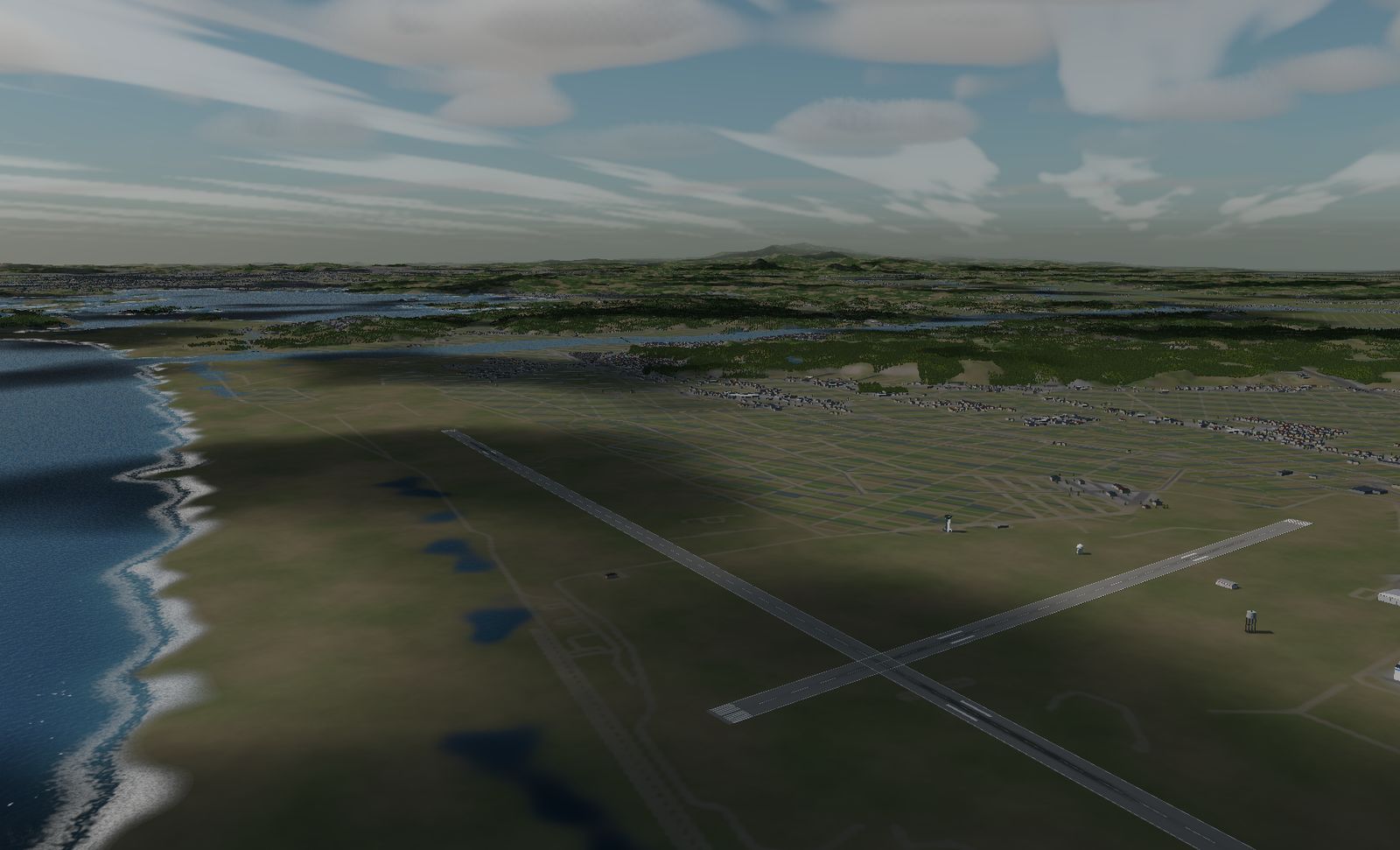
Matsushima Air Base
The home base. Where JASDF pilots actually train on the two-seat F-2B, on a coastal field whose two runways cross in an X — reproduced at full size.
DATA
- Identifier
- RJST / JASDF Matsushima Air Base
- Runways
- RWY 07/25 — 2,701 m × 46 m
RWY 15/33 — 1,500 m × 46 m - Elevation
- About 3 m — essentially sea level
- Based units
- 4th Air Wing, 21st Sqn (F-2B)
11th Sqn "Blue Impulse" (T-4)
Matsushima Rescue Sqn (UH-60J / U-125A) - Area built
- 19.2 × 15.3 km
- Buildings
- 54,188
F-2 MISSIONS starts on this runway. It is the home base you first take off from and the one you come back to.
The real base
Yabuchi, Higashimatsushima, Miyagi prefecture — flat coastal ground on Ishinomaki Bay.
The 21st Squadron based here flies the two-seat F-2B and trains fighter pilots. Aircrew who have finished basic flight training come here to learn combat fundamentals in an actual fighter. In other words, this is where F-2 training really begins. The Blue Impulse display team (11th Squadron) is based at the same field.
There are two runways: the long RWY 07/25 (2,701 m) and the short RWY 15/33 (1,500 m), crossing in an X towards the northeast end. An approach to RWY 07 comes in from over Ishinomaki Bay.
The Tōhoku tsunami submerged 28 aircraft parked at Matsushima, 18 of them F-2Bs. The 21st Squadron moved to Misawa to continue training and returned to Matsushima in March 2016. The apron was raised by 4 m during reconstruction.
The terrain we built
19.2 × 15.3 km from national elevation data. Both runways are flattened along their surveyed end points; everything outside them is the real ground.
There are 54,188 buildings — the town of Yabuchi, the settlements along the shore, and the rice-field grid running inland. West is Ishinomaki Bay; east is the mouth of the Kitakami river. Background rings extend the ground out to the horizon.
What it is like to fly
The long runway is where you learn take-off, climb, turn and landing. At sea level on flat ground, nothing blocks the view once you are up.
You fly the same circuit three times — by day, at night, and in rain. At night the terrain disappears and only the runway and approach lights remain; in rain the pavement is wet and wheel braking is halved. Same shape, completely different flight.
And a box the size of a carrier deck gets painted onto this runway in white. Carrier training starts here, on ground that does not move.
The terrain included varies by edition and platform. See the description of each edition for details.
Elevation data: Geospatial Information Authority of Japan (GSI)